For many foreign travellers, the word shamanism immediately brings to mind ayahuasca ceremonies, visions and mysterious rituals. But Amazonian shamanism is much broader than the consumption of a traditional preparation.
It is a way of understanding the relationship between human beings, plants, animals, rivers, dreams and the invisible forces that Indigenous and local traditions recognise within the rainforest.
In the Peruvian Amazon, knowledge was historically transmitted through observation, oral teaching, plant use, healing songs, periods of isolation and a deep familiarity with the natural environment. The forest was not seen merely as a collection of resources. It was understood as a living territory with its own rhythms, warnings and forms of communication.
Travelling into the rainforest from Iquitos can offer visitors an introduction to this worldview. Not through promises of supernatural experiences, but through conversations with local guides, medicinal-plant walks, stories, moments of silence and respectful explanations about traditions that remain meaningful to many Amazonian families.
What Is Amazonian Shamanism?
Amazonian shamanism is a general term used to describe diverse spiritual, medicinal and ceremonial traditions practised by different Indigenous peoples and local communities.
There is no single form of Amazonian shamanism.
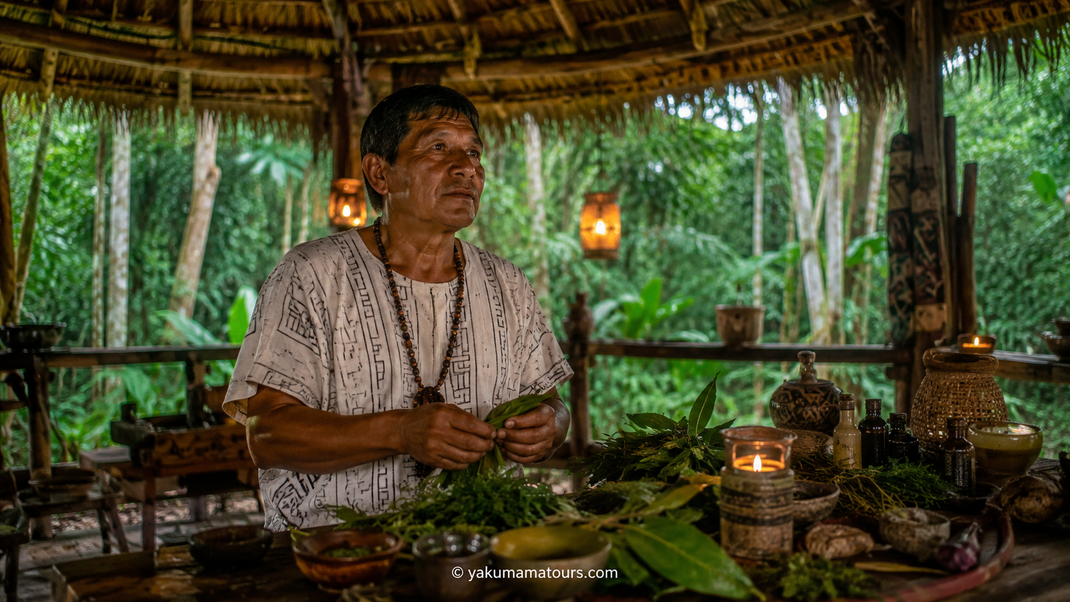
Each community may have its own language, songs, plants, healing methods, restrictions and understanding of the spiritual world. Even the word “shaman” is an external label. In different areas, practitioners may be known as curanderos, vegetalistas, maestros, médicos tradicionales or by names belonging to a specific Indigenous language.
Their knowledge may include:
- Identification and preparation of medicinal plants.
- Traditional songs known in some areas as ícaros.
- Interpretation of dreams and symbolic experiences.
- Spiritual cleansing and protection practices.
- Knowledge of diets, restrictions and plant combinations.
- Guidance during difficult personal or community moments.
- Understanding of the forest, rivers and seasonal changes.
Reducing all of this knowledge to ayahuasca removes much of its cultural meaning.
The Forest as a Living Teacher
Within many Amazonian traditions, knowledge does not come only from books or formal instruction.
It comes from spending time in the forest.
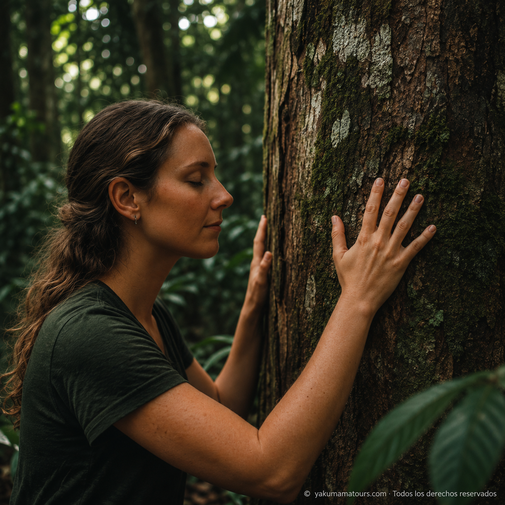
A healer may learn by observing plants, listening to elders, recognising changes in dreams or undergoing periods of disciplined isolation. Certain traditions describe plants as teachers, not because a plant literally speaks in an ordinary human voice, but because knowledge is developed through experience, symbolism, bodily effects and generations of accumulated observation.
For foreign visitors, this idea can be difficult to understand at first.
Modern life often separates medicine, religion, food and nature into different categories. Amazonian worldviews may connect them. A plant can simultaneously have nutritional, medicinal, social and spiritual importance.
This is one reason a guided rainforest walk can become more than a botanical excursion. It can reveal how local knowledge connects plants with stories, precautions, family traditions and ways of interpreting the environment.
Ayahuasca: Tradition, Not Tourist Entertainment
Ayahuasca is one of the most internationally recognised elements associated with Amazonian spirituality. It is a psychoactive preparation used in particular ceremonial traditions, but it does not represent every Amazonian culture or every form of traditional healing.
Responsible information about ayahuasca should avoid several misleading promises.
It should not be presented as:
- A recreational attraction.
- A guaranteed spiritual awakening.
- A cure for depression, trauma or disease.
- A compulsory step for understanding the Amazon.
- An experience suitable for every visitor.
- An ordinary activity automatically included in a jungle tour.
The experience can be physically and psychologically intense. For that reason, cultural learning about ayahuasca is very different from consuming it.
Visitors can learn about its history, ceremonial role, songs, symbolism and controversies without participating in a ceremony. This educational approach is often more appropriate for travellers who are curious but uncertain.
At Yakumama Amazon Tours, wildlife and rainforest programmes are not presented as medical or psychedelic retreats. Any traditional ceremony, when legally and responsibly available, must be treated as a separate adult decision requiring clear information, health screening and qualified supervision.
The experience can be physically and psychologically intense. For that reason, cultural learning about ayahuasca is very different from consuming it.
Visitors can learn about its history, ceremonial role, songs, symbolism and controversies without participating in a ceremony. This educational approach is often more appropriate for travellers who are curious but uncertain.
At Yakumama Amazon Tours, wildlife and rainforest programmes are not presented as medical or psychedelic retreats. Any traditional ceremony, when legally and responsibly available, must be treated as a separate adult decision requiring clear information, health screening and qualified supervision.
What Are Ícaros?
Among the most fascinating elements of some Amazonian healing traditions are the songs commonly known as ícaros.
These songs may be used during ceremonies, healing practices or moments of spiritual concentration. Depending on the tradition, an ícaro may be understood as a way to guide, protect, calm or focus the ceremonial space.
The melodies can be repetitive, delicate or powerful. Some include words in Indigenous languages; others may contain whistles, breaths or sounds associated with the forest.
Ícaros are not simply background music.
For practitioners, they may form part of the knowledge passed down through teachers, family traditions, dreams or periods of learning with plants. Their meaning cannot be fully understood by separating the song from the person, ceremony and cultural environment in which it is performed.
Medicinal Plants Beyond Ayahuasca
The Amazon contains thousands of plant species, and many have long been used locally for food, fibres, construction, insect protection and traditional remedies.
During an interpretive walk, travellers may learn how local people recognise plants by their leaves, bark, scent, roots or growing environment.
The purpose should not be to encourage visitors to prepare or consume unknown plants. It is to understand the depth of knowledge required to distinguish one species from another and to recognise that natural does not automatically mean safe.
Traditional plant knowledge is built through long experience. Some plants may be harmless in one form and dangerous in another. Others may interact with medications or be inappropriate for certain health conditions.
A responsible guide explains cultural uses without turning the forest into a self-service pharmacy.
Can Travellers Experience Amazonian Spirituality Without a Ceremony?
Yes.
A meaningful encounter with Amazonian spirituality does not require consuming any psychoactive substance.
Travellers may approach this worldview through:
- Medicinal-plant interpretation.
- Stories about local beliefs and forest beings.
- Quiet walks focused on sounds and observation.
- Conversations about dreams, healing and family traditions.
- Visits to communities when conducted respectfully.
- Learning about ceremonial songs and symbols.
- Watching the river at sunrise or sunset.
- Spending several nights away from urban noise.
Sometimes the most powerful part of the journey is simply changing the way one observes.
The forest becomes less like scenery and more like a network of relationships.
Why Spend 2, 3 or 4 Days in the Rainforest?
Amazonian knowledge cannot be understood during a rushed visit.
A 2-day journey offers a first introduction through forest walks, river navigation, nocturnal sounds and conversations with local guides.
A 3-day experience provides more time to explore medicinal plants, wildlife, local stories and the contrast between the forest during daylight and after sunset.
A 4-day stay allows visitors to slow down. Activities can be adapted to weather and river conditions, while conversations develop more naturally instead of feeling like a scheduled presentation.
The value of remaining longer is not simply completing more activities.
It is having enough time to notice details, ask better questions and understand that Amazonian spirituality is connected with everyday life, not only with ceremonies.
Cultural Respect and Ethical Tourism
Interest in Amazonian shamanism has grown internationally, but this attention can also create problems.
Traditional knowledge may be simplified, commercialised or presented by people with little connection to the communities they claim to represent. Foreign visitors should be cautious with exaggerated titles, guaranteed transformations and pressure to participate immediately.
Responsible cultural tourism should:
- Avoid treating Indigenous traditions as entertainment.
- Explain that beliefs and practices differ between communities.
- Never guarantee healing or supernatural results.
- Respect intellectual and cultural knowledge.
- Avoid photographing ceremonies without permission.
- Keep wildlife tours separate from psychoactive ceremonies.
- Give visitors time to make informed decisions.
- Recognise that saying no is always acceptable.
Authenticity is not created by dramatic promises. It comes from honesty, context and respect.
Discovering the Spiritual Landscape of Iquitos
Iquitos is more than the entrance to the rainforest.
It is a meeting point where Indigenous knowledge, river communities, urban traditions, Catholic influences, plant medicine and modern tourism have interacted for generations.
Travellers may hear about ayahuasca, ícaros, plant diets, curanderismo, the Yakumama, the Yacuruna and other parts of Amazonian oral tradition. Some stories are spiritual, some medicinal and others explain the dangers or mysteries of the forest and rivers.
Exploring these subjects responsibly gives visitors a deeper understanding of Loreto.
The objective is not to decide whether every belief is scientifically measurable. It is to understand why these traditions exist, how they influence local identity and why they continue to matter.
A Journey That Begins with Curiosity
The Amazon does not reveal itself through a single ceremony or a photograph.
It reveals itself gradually.
Through the sound of insects after sunset.
Through a guide explaining why one tree is avoided and another is respected.
Through the silence before an animal appears.
Through stories carried by families and communities.
Through several days of travelling, walking, listening and observing.
For visitors seeking more than a conventional holiday, a 2, 3 or 4-day rainforest experience from Iquitos can become an introduction to the cultural and spiritual landscape of the Peruvian Amazon.
Not through promises of miracles.
Through knowledge, humility and direct contact with the forest.
Escribir comentario